Green Code Climatic Slab®
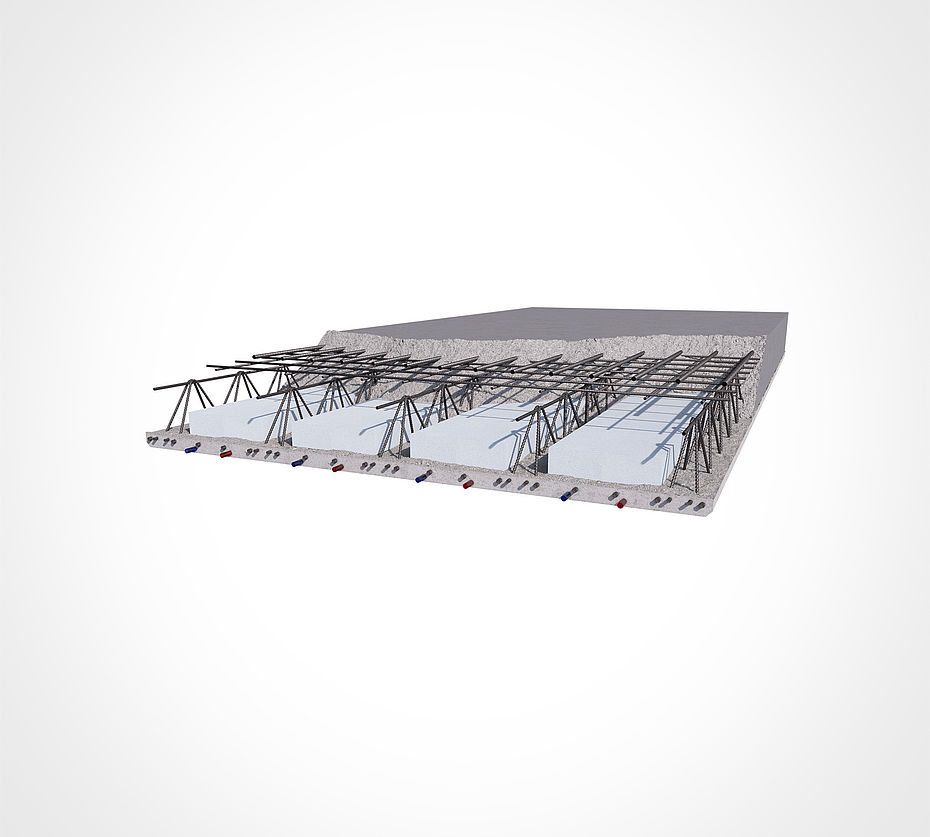

The Green Code Climatic Slab heats or cools the room as needed: through the exchange of thermal radiation, it directly tempers the floor, the walls, the furniture and all other furnishings - not the air. Since there are no obstructions such as furniture on the ceiling, they avoid convection and its undesirable side effects: When heating, hardly any dust is swirled into the air, and when cooling, there is no cold draft. In addition, heat radiation in combination with warm walls prevents the formation of mold. This ensures a healthy and comfortable indoor climate.
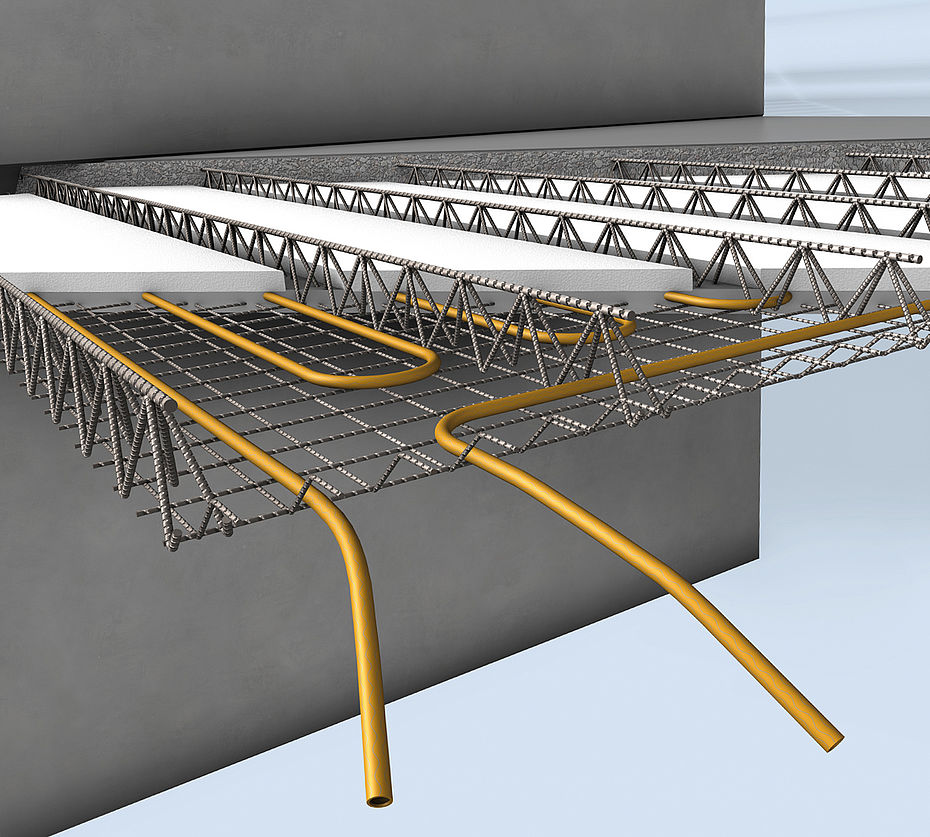

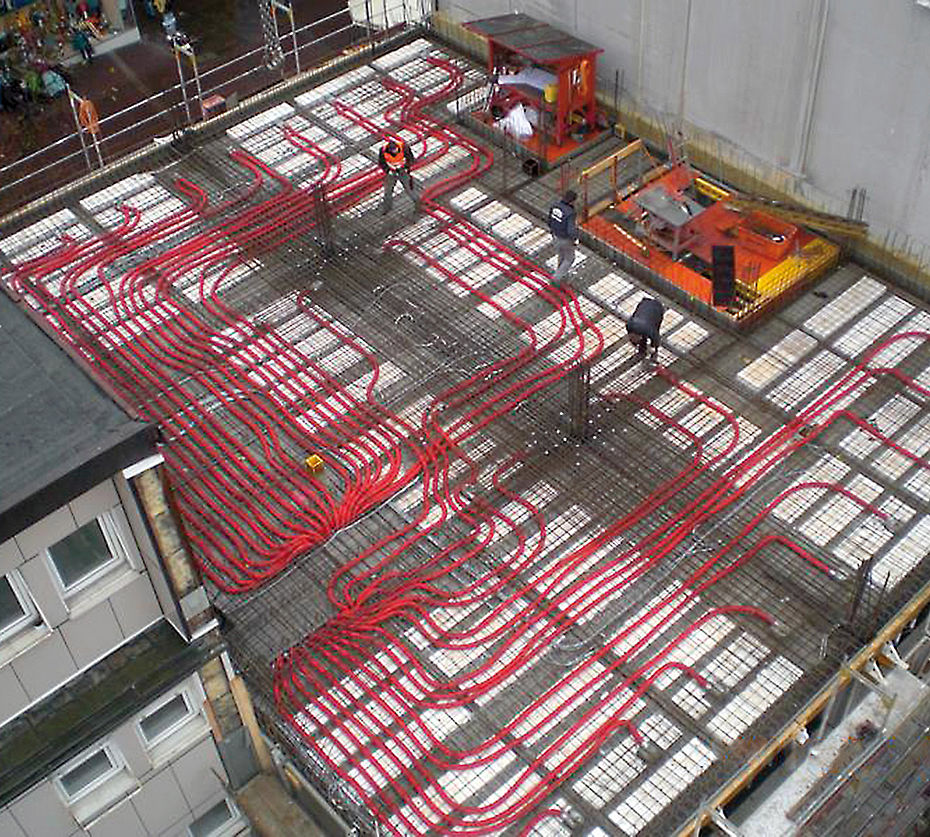
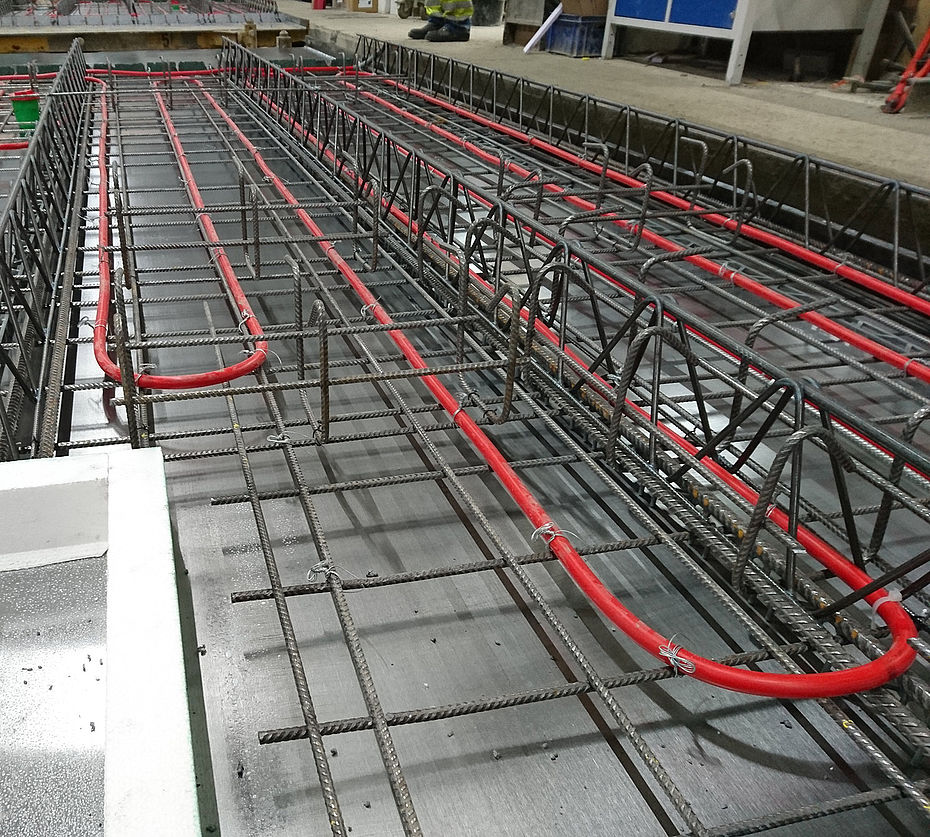
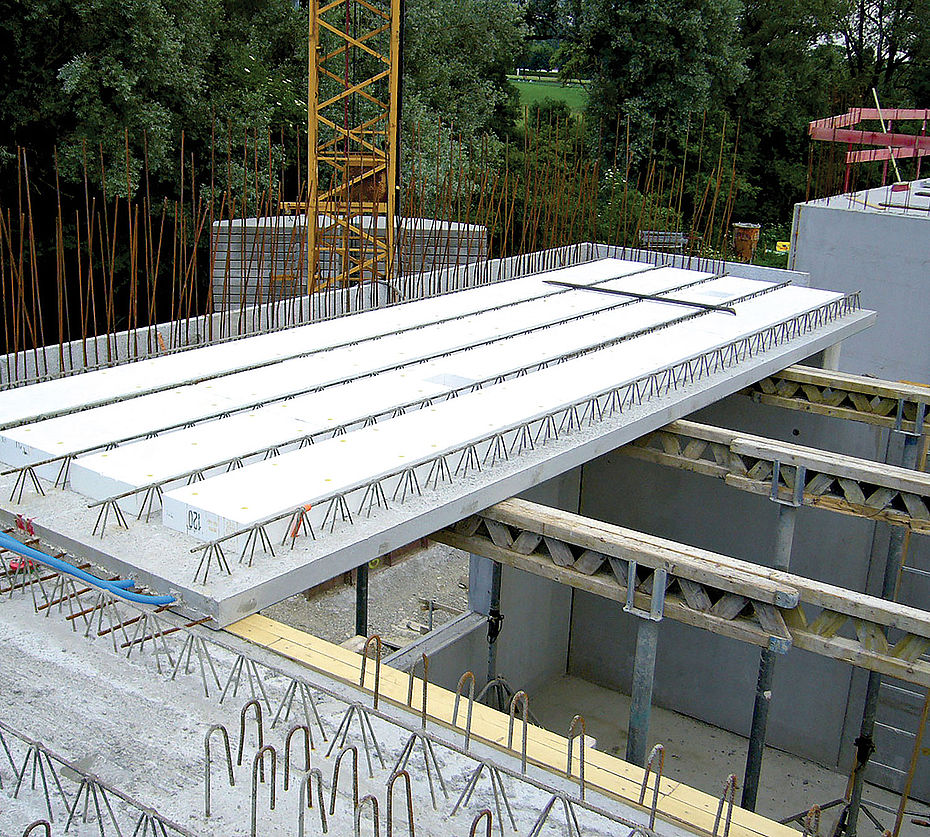
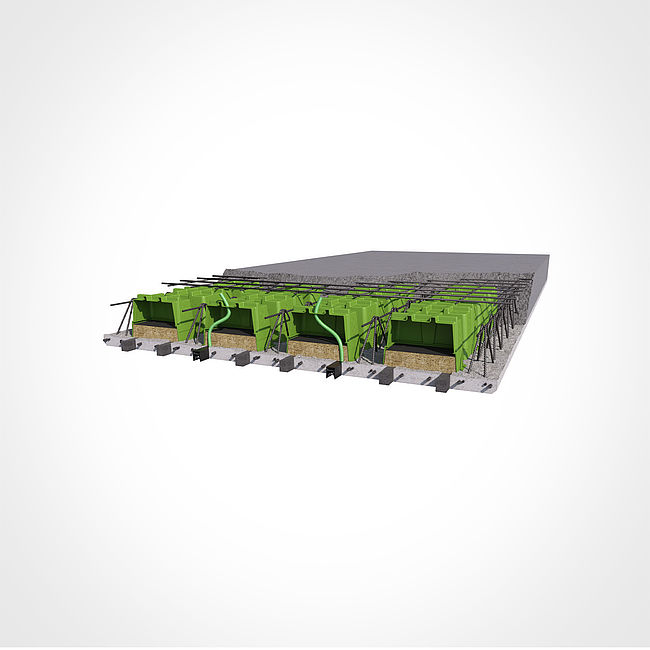
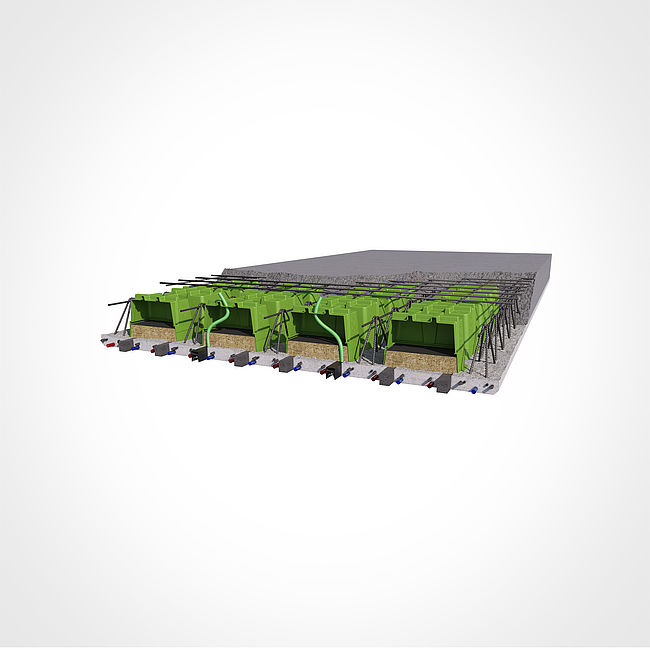
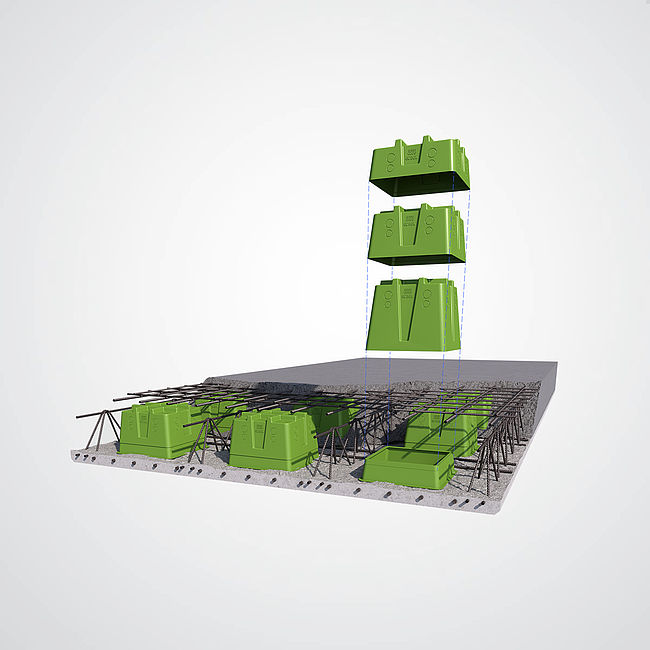
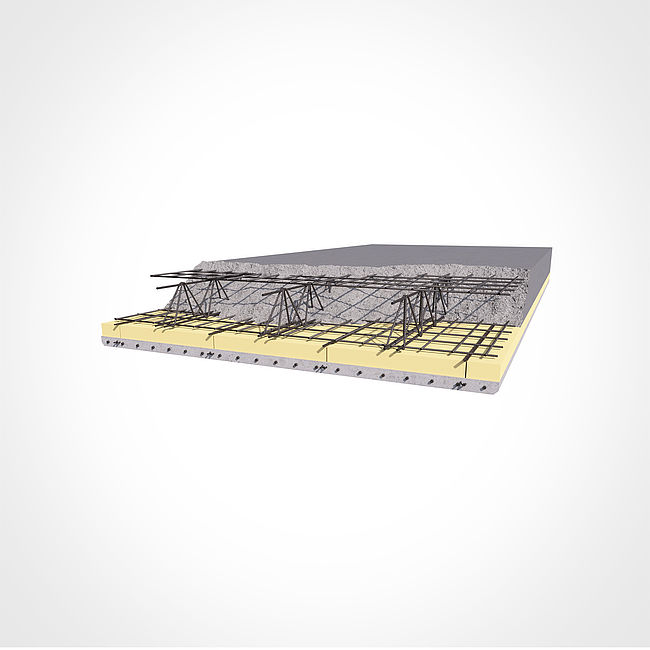
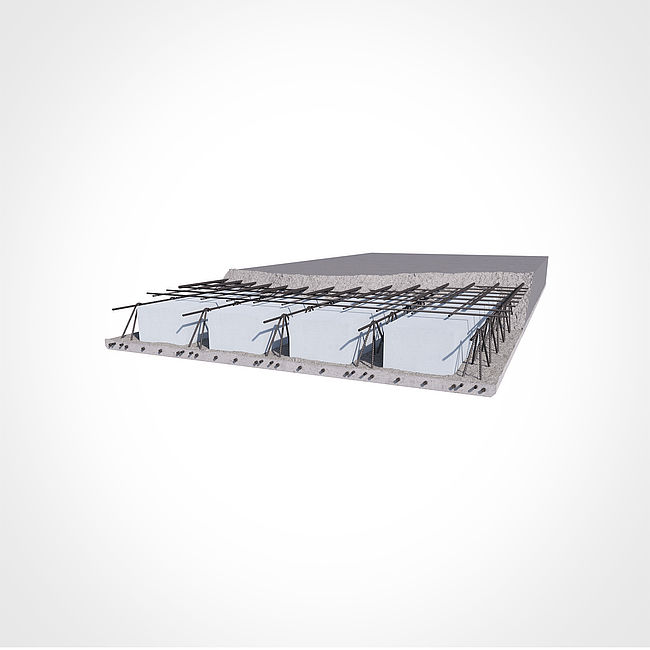
The Green Code Climatic Slab is an industrially prefabricated slab element with pipe registers close to the surface and integrated insulating elements. Lattice girders, load-bearing longitudinal reinforcement, minimum transverse reinforcement, and if required shear reinforcement. The reinforcements is integrated in the concrete slab direclty in the factory. The underside boasts furthermore a metal formwork-smooth finish. The heating and cooling registers integrated in the elements are made of tubes. Based on the heat and cooling demand calculation, the tube spacing is optimized and planned individually for each room. Through the built-in insulating elements, a shorter reaction time and thus a faster temperature change in the room is guaranteed. In addition, the insulation layer prevents a long reverberation time of the whole ceiling. After the elements are installed on site, additional reinforcement layers are placed, the tube registers are properly connected to the distributors, and the in-situ concrete is poured. The result is a dynamic, thermally activated, monolithic ceiling system.
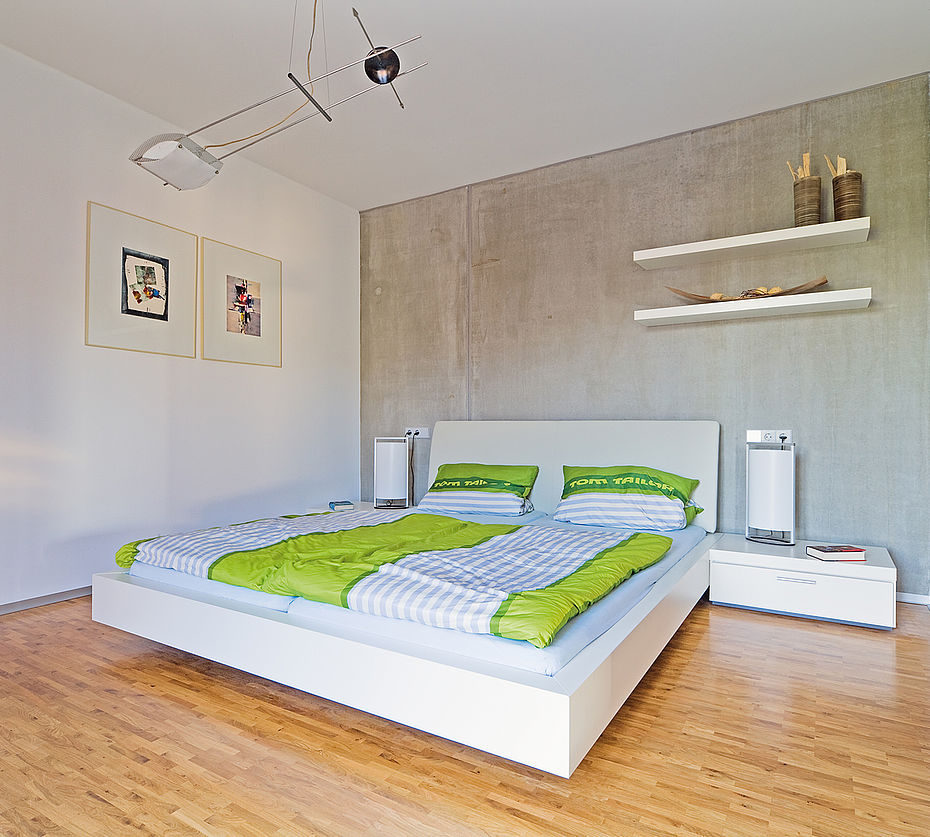

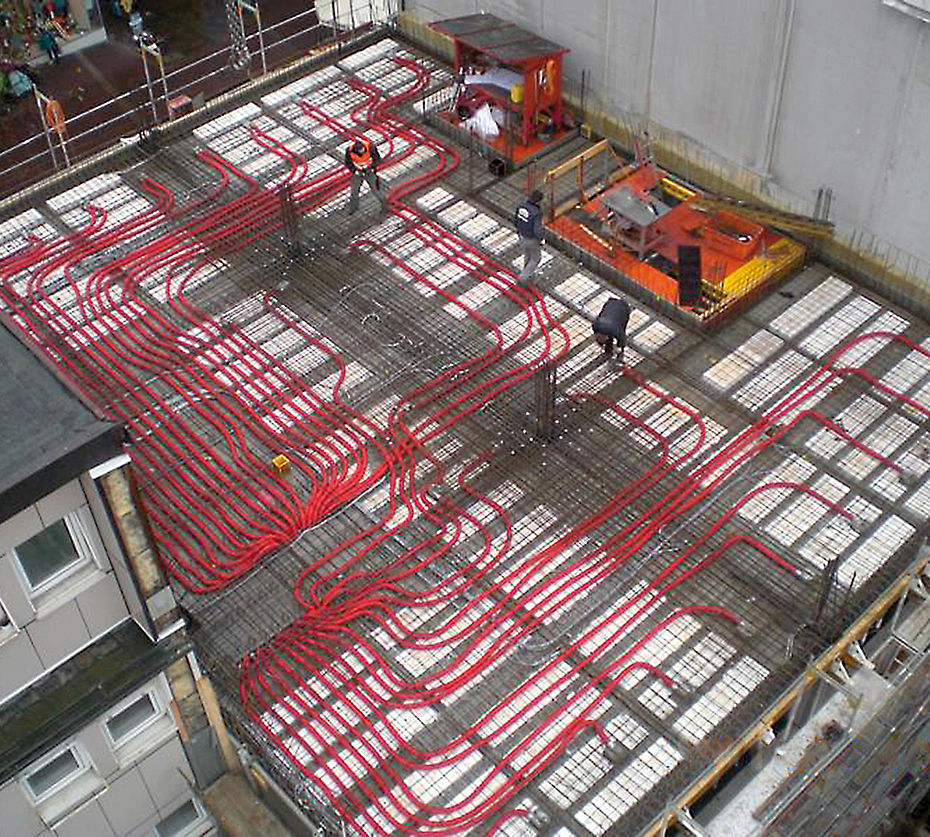
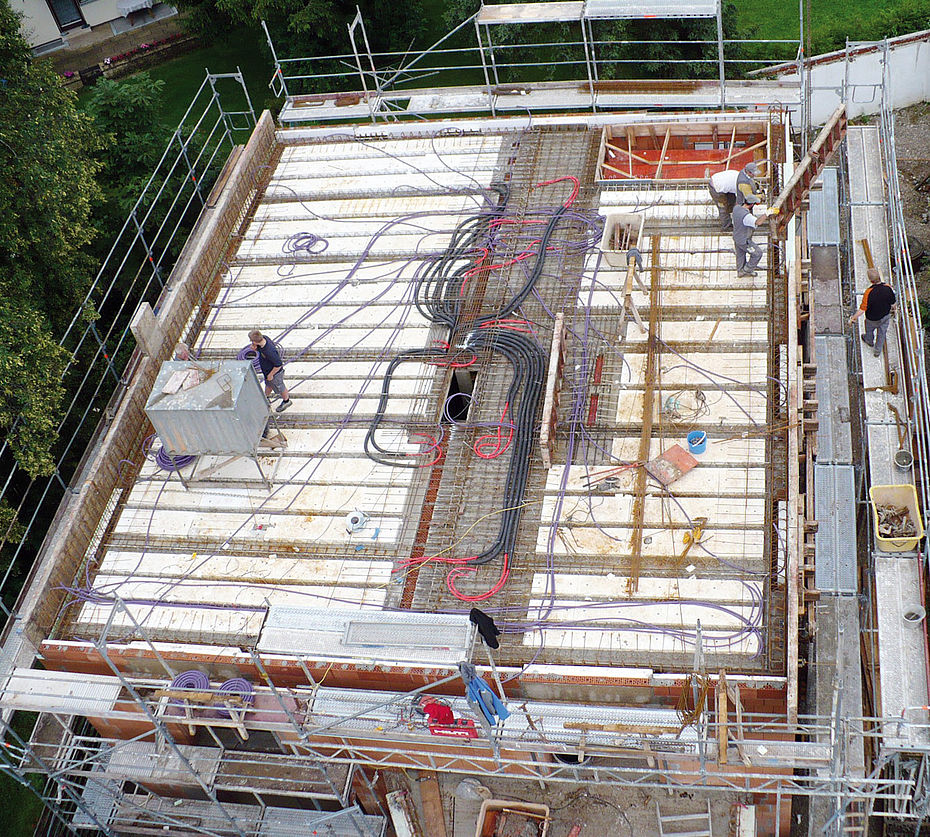
In addition, Green Code Climatic Slabs can be equipped with sound absorbers flush with the surface to also optimize room acoustics. In other words, a combination of Green Code Acoustic Slabs and Green Code Climatic Slabs. After all, noise and long reverberation times are a major stress factor in the workplace and at home. The sound absorbers reduce the reverberation to the calculated ideal value for the planned room use and thus contribute to the well-being and a productive working atmosphere.
Warm - No overheated air
(Kopie 3)
Wir erwärmen nicht die Luft, sondern die Objekte, den Boden, die Wände, die Möbel – alles, was sich in den Räumen befindet. Dazu verlegen wir Rohre in der Decke und erwärmen diese sanft auf Oberflächentemperaturen von ca. 26 °C. Die Energie wird nun als Wärmestrahlung in den Raum abgegeben. Dort, wo die Wärmewellen auf Gegenstände treffen, werden diese erwärmt. Auch die Luft, die an der Green Code Decke anliegt, wird erwärmt, muss nicht mehr aufsteigen bzw. ist schon oben und bildet ein dünnes Warmluftpolster unter der Decke. Die Wärme wird nicht abgeführt, die Luft beginnt nicht zu zirkulieren. Die Wärmeenergie muss folglich als Wärmestrahlung in den Raum abgegeben werden. Alle Körper im Raum – Boden, Wand, Sofa, Tisch, sogar das Fensterglas – nehmen die Wärmeenergie auf. Folglich sind alle Körper wärmer als die Luft. Die Luft erwärmt sich an den Körpern, nicht umgekehrt. Der Fußboden, das Sofa, der Stuhl etc. sind warm. Deshalb kann die gemessene Lufttemperatur bei Wärmewellenheizungen ca. 3 °C niedriger liegen als bei Konvektionsheizungen – das Thermometer zeigt 20 °C und es fühlt sich an wie 23 °C. Dies fördert das Wohlbefinden und spart auch noch ca. 18 % Energie.
Normale Heizkörper geben die Wärme konstruktionsbedingt nur zu einem geringen Teil als Wärmestrahlung ab. Die meiste Wärme wird an die anliegende Luft abgegeben, warme Luft steigt auf in Richtung Decke und kältere strömt nach. Die Luft des gesamten Raumes beginnt zu zirkulieren und Körper im Raum – Boden, Wand, Sofa, Tisch etc. – werden nur von der vorbeistreichenden Luft erwärmt, sind also immer kälter als die Luft. Die Temperaturunterschiede der Luft von oben nach unten sind sehr groß, was als unbehaglich empfunden wird. Durch Luftzirkulation aufgewirbelter Hausstaub beeinflusst die Gesundheit: Mit der zirkulierenden Luft kommt der abgelagerte Hausstaub in Bewegung, wird mitgerissen und in der gesamten Raumluft verteilt bzw. in Schwebe gehalten. Hausstaub, diese unappetitliche Mischung aus Hautschuppen, Milben, Milbenkot, Schimmelpilzen, Sporen, Fasern, Haaren, Ruß, Pollen, chemischen Stoffen, Weichmachern etc., die trocken in der Nase klebt und nicht nur bei Allergikern ernsthafte gesundheitliche Probleme auslösen kann.
Das Prinzip der Wärmestrahlung
- Wärmestrahlen sind wie Lichtstrahlen energetische Wellen und werden auch als infrarotes Licht oder Wärmewellen bezeichnet.
- So wie die Frequenzen des sichtbaren Lichtes mit den Augen wahrgenommen werden, so werden die Wärmestrahlen mit den Wärmerezeptoren in der Haut gespürt.
- Wärmestrahlen werden von allen festen Körpern abgegeben und von allen festen Körpern aufgenommen. Mittels Wärmewellen wird die Wärme direkt von Objekt zu Objekt übertragen, wodurch ein Ausgleich stattfindet: Kühlere Objekte nehmen mehr auf, als sie abgeben und erwärmen sich – wärmere Objekte geben mehr ab und werden kühler.
- Intensive Wärmestrahlung erleben wir, wenn wir das Gesicht zur Sonne drehen oder uns einem großen Lagerfeuer nähern.
- Der Mensch sendet Infrarotstrahlung über die Haut mit einer Wellenlänge von ca. 2,3 µm aus.
Cool - No chilly air
In der warmen Jahreszeit drehen wir das System der Green Code Decke einfach auf Links. Das Prinzip der Wärmestrahlung wird aber auch hier genutzt: Wir durchströmen die Rohrleitungen in der Decke mit kaltem Wasser. Wärme, die von den Wänden, dem Boden, den Möbeln und auch den Menschen abgestrahlt wird – und die aufgestiegene warme Luft erwärmen die Decke. Das zirkulierende Wasser in den Rohren erwärmt sich, führt die Wärmeenergie ab und kaltes Wasser strömt nach. So kühlt sich der gesamte Raum ab. Alle Gegenstände im Raum geben ihre Energie an die Decke ab, werden kühler und können nun verstärkt die Wärmestrahlen der Menschen aufnehmen. Die Umgebung kühlt sich also merklich ab: Wir schwitzen weniger, weil die überschüssige Körperwärme mehr über Strahlung und weniger über Verdunstung abgegeben wird. Die gefühlte Raumtemperatur ist um ca. 2–3 ºC niedriger als die gemessene Lufttemperatur – perfektes „Wohnfühl“-Klima.
In Gebäuden mit hohem Isolationsstandard wird das Thema Kühlen bald wichtiger als das Thema Heizen. Nicht nur in Büroräumen, auch in Wohngebäuden wird über Sonneneinstrahlung, Lampen, elektrische Geräte, Computer und auch den Menschen viel Wärme erzeugt und die Innentemperatur wird schnell unangenehm warm. Green Code bietet die Lösung in einem System für jede Jahreszeit: Die gute Dämmung der Thermowand hält nicht nur im Winter die Kälte, sondern auch im Sommer die Hitze draußen. Ein wohltemperiertes Wohn- und Arbeitsklima bei vergleichsweise geringem Energieverbrauch.
Die beste Ökobilanz erreichen Sie, wenn die Energie vom eigenen Dach kommt. Wer konsequent nachhaltig denkt, kann die entstehende Abwärme über eine Wärmepumpe zur Brauchwassererwärmung verwenden – eine sehr intelligente Art, solare Energie passiv zu nutzen.
Advantages
Climatic Slab in heating setting
- Warm - without overheated air
- short reaction times through superficial installation of the registers
- each room, even down to individual zones, can be controlled separately
- cost saving during heating , because the "feel good" room temperature is approx. 3 °C lower (approx. 6 % heating energy saving per 1 °C)
- low flow temperatures, because in the ceiling 100% active surface - no piece of furniture or floor covering obstructs (covers) the heating surface
- particularly suitable for regenerative energy generation such as heat pumps and solar thermal energy, as only low flow temperatures are required
- particularly comfortable feeling of warmth through even heating of all objects via radiation heating
- no dust whirling up, because only low convection
- no air layering, but uniform heat throughout the rooms
- higher humidity = health protection (mucous membranes are kept moisturized)
- Can be combined with acoustic slab
(Kopie 6)
Climatic Slab in cooling setting
- Cool - but no chilly air
- short reaction times through surface installation of the registers
- each room, even individual zones, separately controllable
- Energy savings, as the "feel good" room temperature is approx. 2-3 °C higher (e.g. at 26 °C instead of 24 °C): less cooling required
- higher flow temperatures, as 100% active surface in the ceiling - no furniture or floor covering obstructs (covers) the cooling surface
- very high cooling capacity through combination of Green Code ceiling and wall system
- Waste heat can be reused
- Can be combined with acoustic ceiling
Technical specifications
(Kopie 7)
Climatic Slab in heating setting
- Heat output* 82.34 W/m² based on DIN EN 1264-2 | ∆t 15K; Higher outputs (even above 120 W/m²) are possible depending on the design, material selection, tube spacing, system temperature and the ∆t to the (also operative) room temperature.
- active area share: up to100%
- Response time from approx. 15 minutes
Note: When designing ceiling heating systems, the instructions from DIN EN 1264-3 and ISO 7730 must be observed. We are happy to assist with the calculations.
(Kopie 8)
Climatic Slab in cooling setting
- Cooling capacity* 74.10 W/m² based on DIN EN 1264-2 | ∆t 10K. Higher capacities (up to more than 90 W/m²) are possible at any time depending on the design, material selection, tube spacing, system temperature and the ∆t to the (also operative) room temperature or/and in case of asymmetric loads (e.g. glass facades).
- active area share: upt o 100%
- Response time from approx. 15 minutes
Note: When designing ceiling cooling systems, the information from DIN EN 1264-3 and ISO 7730 must be observed. The respective additional heat transfer resistances are known from Part 5 of DIN EN 1264. We will be happy to assist with the calculations.
The Green Code ceiling in combination with suspended ceilings
(Kopie 9)
Der Einsatz von Fertigteildecken ist nicht immer möglich oder sinnvoll. Deshalb bieten wir Ihnen eine Trockenbaulösung, mit der Sie die Klimadecke an schwierigen Stellen oder in abgehängter Version ergänzen können. Zum Beispiel bei Dachausbauten oder wenn Sie bei großflächigen Geschossen eine zentrale Verteilung aller Leitungen über die Flurdecke planen. Das hat den zusätzlichen Vorteil, dass Sie sich dort den Zugang zu Lüftung und Heizung bewahren.
Wie bei der Klimadecke in Beton liegen die Heiz- und Kühlregister nahe an der Oberflache, was kurze Reaktionszeiten zur Folge hat. Und wie die Betondecke nutzt auch unsere Trockenbau-Klimadecke 100 % ihrer Fläche zum Heizen und Kühlen. Über getrennte Kreisläufe sind alle Räume separat regulierbar und große Flächen können in Zonen aufgeteilt werden.